Novel Peptide for Autoimmune Disease

The Mechanism of Action (MOA) of peptide therapeutics targeting autoimmune and inflammatory diseases centers on restoring immune tolerance and dampening aberrant inflammation without causing the broad, systemic immunosuppression typical of conventional biologics or small molecules.
Rather than shutting down the immune system, therapeutic peptides act as precise immunomodulators. They function primarily through three integrated pathways: Antigen-Specific Immunotherapy (ASIT), direct anti-inflammatory signaling, and phenotypic remodeling of immune cells
NBRLBoston Developing the Peptide for Autoimmune Diseases
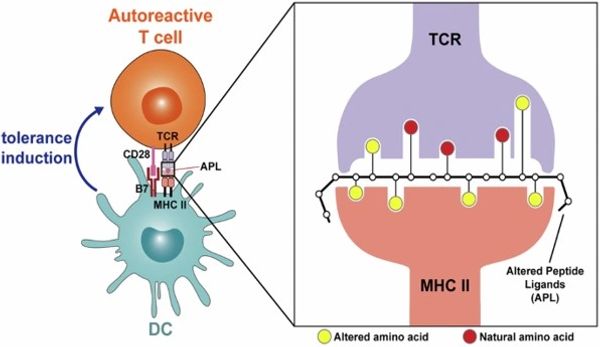
Antigen-Specific Immunotherapy & Immune Tolerance
The most groundbreaking mechanism of peptide therapeutics in autoimmunity is the induction of antigen-specific peripheral tolerance. By delivering fragments of self-proteins (epitopes or mimotopes) under non-inflammatory conditions, these peptides "retrain" the immune system .
- T-Cell Anergy and Deletion: When synthetic peptides bind to Major Histocompatibility Complex (MHC) molecules on Antigen-Presenting Cells (APCs) without proper co-stimulatory signals, autoreactive T-cells are either rendered unresponsive (anergy) or driven into programmed cell death (deletion).
- Altered Peptide Ligands (APLs): Some peptides are designed to structurally mimic a self-antigen but carry slight conformational modifications. This creates an unproductive or weak TCR-MHC binding, shifting the T-cell response from a destructive, pro-inflammatory state (Th1/Th17) toward a protective, regulatory state.
- Bypassing Neoepitopes: Advanced platforms target newly identified "hybrid insulin peptides" or "neoepitopes"—which bypass early thymic selection and drive diseases like Type 1 Diabetes—to neutralize high-frequency autoreactive T-cells directly.

Cellular Remodeling: Treg and Dendritic Cell Modulation
Peptides structurally influence the balance of immune cell populations to promote a sustained tolerogenic environment:
- Expansion of Regulatory T-Cells (Tregs): Many autoimmune peptides (such as Thymosin Alpha-1) selectively expand Treg populations. Tregs actively secrete suppressive cytokines and keep effector cells from attacking healthy tissues.
- Induction of Tolerogenic Dendritic Cells (tDCs): Peptides influence the maturation of dendritic cells, pushing them toward a "tolerogenic" phenotype. Instead of presenting self-antigens as dangerous threats, these tDCs present them as benign, suppressing downstream T-cell activation.
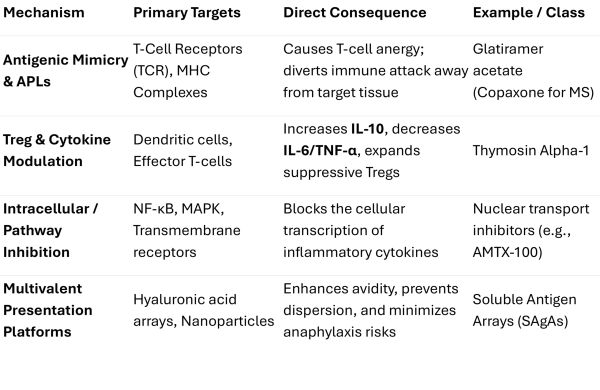
Direct Comparison Mechanisms of Action

NBRLBoston Developing the Peptide for Autoimmune Diseases
1. The IL-23R Pathway (Upstream Th17 Regulation)
- Mechanism of Action: This macrocyclic peptide explicitly binds to the Interleukin-23 receptor (IL-23R) on the surface of T-helper 17 (Th17) cells. By blocking IL-23 from docking, it completely disrupts the downstream phosphorylation of JAK2/TYK2 and the dimerization of STAT3.
- Therapeutic Impact: Because IL-23 is the upstream "master switch" for Th17 survival, blocking it halts the secretion of multiple chronic tissue-destroying cytokines (like IL-17A, IL-17F, and IL-22). This structural target provides durable relief in conditions like plaque psoriasis and inflammatory bowel disease (IBD).
2. The IL-17A / IL-17RA Pathway (Downstream Blockade)
Mechanism of Action: While IL-23 acts upstream, IL-17A is the actual executioner molecule of local inflammation.
Peptides targeting this axis work in one of two ways:
A. Ligand Blockers (IL-17A): Competitively mask the active binding region of the IL-17A homodimer, preventing it from touching the receptor.
B. Receptor Blockers (IL-17RA): Bind directly to the IL-17RA subunit, disrupting the recruitment of the crucial Act1 adaptor protein.
3. The α4β7 / MAdCAM-1 Pathway (Gut-Selective Trafficking)
- Mechanism of Action: Autoimmune pathology in the gut relies on systemic T-cells migrating into intestinal tissue. Pathogenic T-cells express the integrin α4β7 on their surface, which acts as a "key." The endothelial lining of the gut displays MAdCAM-1, which acts as the "lock." Synthetic cyclic peptides bind with high affinity to the α4β7 integrin headpiece, preventing this physical binding.
- Therapeutic Impact: By physically gumming up the lock-and-key mechanism, the peptide locks circulating white blood cells out of the gut. Because MAdCAM-1 is highly specific to intestinal tissue, this localized blockade resolves Ulcerative Colitis and Crohn’s disease without triggering systemic immune deficits in the rest of the body.
All Three targets therapeutic peptides have been selected and optimized for in vitro and in vivo evaluation